
By Gregory Lemmon | Managing Director, UBIQUITY Ltd
Cybersecurity & Disaster Recovery Consultants to the Caribbean 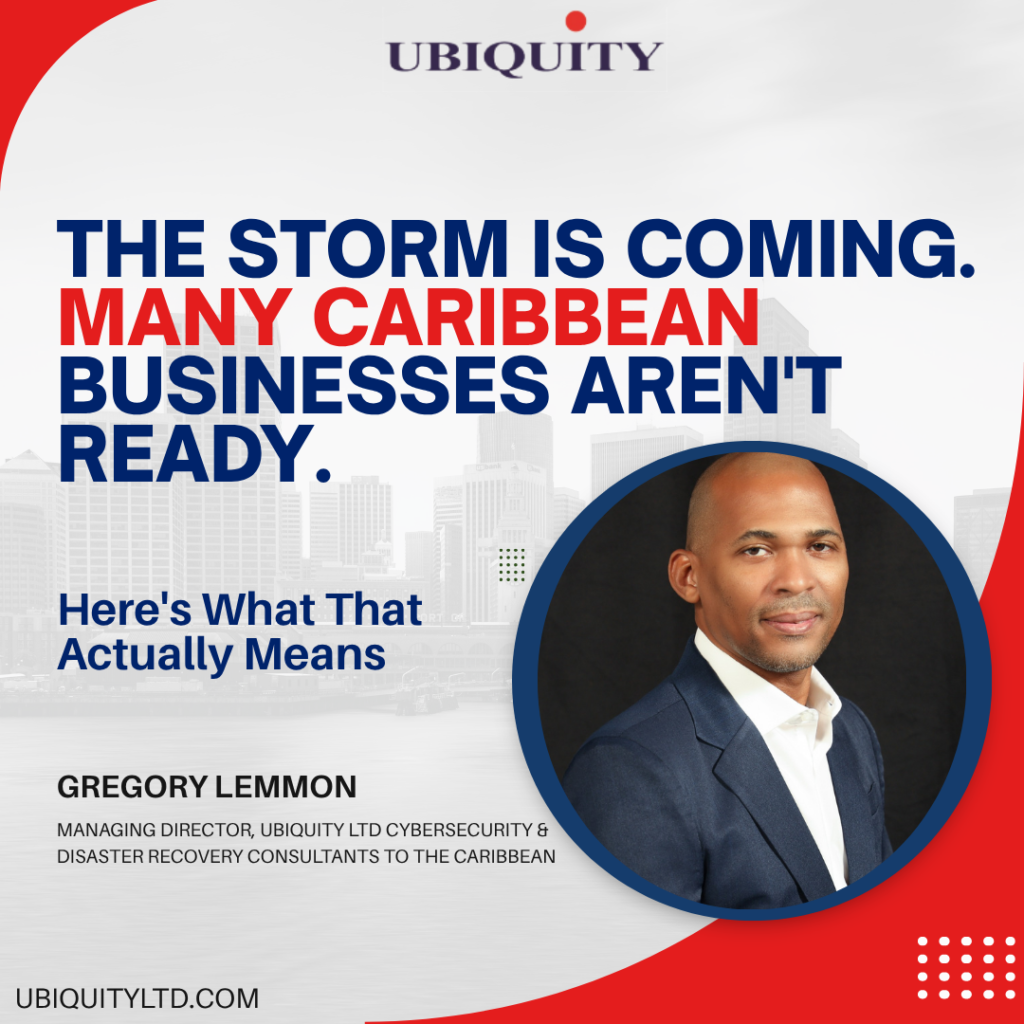
Every year, the Atlantic Basin wakes up.
Between June and November, the Caribbean holds its breath. Businesses board up windows. Families stock supplies. Governments issue warnings. And then, usually, life goes on.
But every few years, it doesn’t.
And in those years, the difference between businesses that survive and thrive and businesses that don’t is not only because of the size of the storm.
It has a lot to do with what they did before it arrived.
When Caribbean business owners think about hurricane preparedness, they often only think about the physical. The building. The generator. The insurance policy.
Not enough focus goes into the security of their data.
And I understand why. Data is invisible. You can’t board it up. You can’t move it to higher ground. You can’t see it sitting in a filing cabinet waiting to get wet.
But it’s there. On a server. In your office. On a hard drive that costs about as much as a decent office chair. And when that server gets flooded, surged, or simply knocked offline for three weeks the data on it is in danger.
Client records. Financial history. Contracts. Employee files. Supplier agreements. Years of work, relationships and institutional knowledge, gone in hours.
And here is the part that doesn’t make the news: for approximately 60% of businesses that suffer a major data loss, that’s the end. Not the storm. Not the physical damage. The data loss. They never reopen.
There’s a second threat that hits Caribbean businesses especially during hurricane season, and almost nobody is prepared for it.
Cybercriminals.
I know that sounds like something for a different conversation. But hear me out.
When a major storm is tracking toward the Caribbean, every business owner in its path is watching the weather, managing their team, coordinating with suppliers and trying to keep everything together. Their attention is stretched thin.
That’s exactly when cybercriminals move.
They know your IT team is distracted. They know your staff are working from home on their personal Wi-Fi. They know your systems are going unmonitored. They know you’re exhausted and more likely to click on a phishing email disguised as a storm relief update.
Last year, 61% of small and medium businesses globally were hit by a cyberattack. During periods of natural disaster, that number climbs. The average cost of a single cyber incident for a Caribbean SMB? Around USD $200,000.
The storm outside and the storm in your inbox are both significant problems.
What I’ve Seen Working With Caribbean Businesses
Over the years, working with businesses across the Caribbean, I’ve seen both sides of this story play out.
I’ve seen businesses call us the week after a hurricane, desperate, asking if we can recover data from a server that spent three days being battered by hurricane water. Sometimes we can help. Often we can’t. And watching a business owner realise that years of client data is simply gone, that’s not something you forget.
I’ve also seen the other side.
Businesses that barely noticed the storm passed. Their data was protected and in the cloud. Their team was working remotely within days. Their clients experienced minor disruption at most. They didn’t lose a single file. And while their competitors spent weeks trying to recover, they were already moving forward.
The only difference between those two businesses was a decision made before the storm arrived.
Genuine disaster preparedness for a Caribbean business isn’t complicated. But it does require intention. Here’s what it actually covers:
Your data needs to live somewhere other than your office. Cloud backup isn’t optional anymore. It’s the baseline. Your data should be automatically backed up, stored offsite, encrypted and recovery tested. Not assumed. Actually tested and verified restorable.
Your team needs to be able to work from anywhere. If your building is inaccessible for two weeks, can your team serve your clients from home? Do they have secure access to the files and systems they need? Is your communication infrastructure cloud-based? These aren’t theoretical questions anymore.
Your systems need to be protected even when nobody is watching. Cybersecurity doesn’t pause because a storm is coming. If anything, the risk increases. Multi-factor authentication, endpoint protection and monitoring need to be running continuously, not just when everything is calm.
You need a written, tested recovery plan. Not a mental note. Not a general idea. A documented plan that tells your team exactly what to do in the first 24, 48 and 72 hours after a disaster. Who calls whom? What gets restored first? How do clients get notified? What does the chain of command look like when the normal routine is gone?
When I sit down with business owners, I ask them one question:
If your office became inaccessible tomorrow morning how quickly could your business be operational again?
Most pause.
Some say yes within a couple of days and mean it. They’ve done the work.
Most say they don’t know. And that uncertainty, right there, is the risk.
Not the hurricane. Not the hackers. The not knowing.
Because a business that doesn’t know if it could survive a disaster almost certainly couldn’t.
Hurricane season 2026 has already started. The Atlantic is warm. Forecasters have predicted above-average activity across the Caribbean basin. Jamaica, Barbados, Trinidad, the Cayman Islands, Antigua, St. Lucia, Grenada, St. Kitts & Nevis, BVI unfortunately no island is outside the risk zone.
And while we can’t control the weather, we can control how prepared we are.
The businesses that come through hurricane season intact operationally, financially, digitally aren’t the ones that got lucky. They are the ones that made a decision long before June or July, before anything happened, to get serious about protection.
That decision doesn’t have to be complicated.
It just has to be made and supported with the right resources.
I’ve spent years helping Caribbean businesses build the systems and protections that keep them running through the seasons. And the one thing I know for certain is this:
No one ever regrets being prepared.
Not a single business owner has ever called me after a hurricane and said “I wish I hadn’t backed up my data.” Or “I wish I hadn’t set up that recovery plan.”
But I’ve had too many conversations that went the other way.
Don’t let this be the season you have that second conversation.
We help Caribbean businesses build real, tested Disaster Recovery plans and Cybersecurity solutions that keep them operational, storm season or not.
This hurricane season, we’re offering free Disaster Recovery Assessments for businesses across the Caribbean. No obligation. Just a clear, honest look at where you stand and what needs to change.
Because the best time to prepare was last year, the second best time is today.
Book your free assessment at ubiquityltd.com
Email us at – info@ubiquityltd.com
Call us at 1-284-547-6754
Calendly Link- https://calendly.com/glemmon-wpi/15min?month=2026-07